
CHAPTER VII
Transplants in Foreign Countries Among Patients Removed from the U.S. Transplant Waiting List
OVERVIEW
Transplant tourism, where patients travel to foreign countries specifically to receive a transplant, is poorly characterized.
Waiting list removals for transplant without a corresponding U.S. transplant in the database were reviewed via a data validation query. Also, waiting list removal records with text field entries indicating a transplant abroad were identified.
373 foreign transplants (173 directly noted; 200 from data validation) were identified; most (89.3%) were kidney transplants.
Between 2001 and 2006, the annual number of waiting list removals for transplant abroad increased.
Male sex, Asian race, resident and non-resident alien status, and college education were significantly and independently associated with foreign transplant.
Recipients from 34 states, plus the District of Columbia, received foreign transplants in 35 countries, led by China, the Philippines, and India.
The data reported here represent the minimum number of cases and the full extent of this practice cannot be determined using existing data.
As the demand for organ transplantation continues to overshadow the available supply of both deceased and living donor organs, some patients have turned to opportunities in countries other than that of their permanent residence to receive transplant services. The term transplant tourism has been used to describe this practice, which may involve travel on the part of the potential recipient, the potential donor, or both. Travel to foreign countries, specifically to receive a transplant, is a very poorly characterized activity among patients on the deceased donor waiting list in the U.S. This study examined national data to determine the minimum documented scope of this practice.
[TOC]Waiting list removal data from 1987-2006 from the Scientific Registry of Transplant Recipients (SRTR) database based on data from the Organ Procurement and Transplantation Network (OPTN) were analyzed. Waiting list removal reasons are coded in the data. Valid codes for waiting list removal reasons include receipt of a transplant, death, becoming too sick for transplant, becoming too well for a transplant, patient choice, and several additional codes.
Two methods were used to identify cases of transplantation in a foreign country of candidates who were removed from a U.S. waiting list. For waiting list removals that do not appropriately fit within one of the existing removal codes, a designation of “other” is available to the center, and an optional text field may be completed to give additional information, including an entry that directly indicates that a transplant took place in a foreign country. Listing dates for cases with a waiting list removal code of “other” and a text field entry indicating a foreign transplant ranged from May 2, 1986 to September 29, 2006, and corresponding removal dates ranged from November 1, 1990 to November 1, 2006.
The second method entailed a data validation study. A waiting list removal reason code indicating that transplantation occurred at a center other than the listing center is also available. Waiting list removals for transplantation at a center other than the listing center, and where a corresponding U.S. transplant could not be identified in the database, may represent cases of transplantation in a foreign country. However, the existing data collection system does not allow the center to directly indicate the “other center.” The data validation study, approved by the Health Resources and Services Administration (HRSA) to be conducted under the SRTR contract, was conducted for all such cases that occurred for candidates listed between August 23, 1994 and May 5, 2006, with corresponding waiting list removal dates that ranged from January 20, 1999 to October 3, 2006. Each center was asked to provide more detailed information about such cases, in order to ascertain whether the coding was correct, whether a transplant had indeed taken place, and if so, where the transplant took place.
Characteristics of candidates who were determined by either of the two methods to have been transplanted in a foreign country were tabulated and compared to other candidates on the waiting list for whom no removal information suggestive of foreign transplant was present. Demographic, socioeconomic, citizenship, and residence data for foreign transplant and cases not associated with identified foreign transplants were compared using chi-square tests. A Cox regression model was fitted to identify variables associated with foreign transplant. All analyses were conducted using SAS version 9.1.
[TOC]There were 173 instances where the waiting list removal code directly noted a foreign transplant. At the time of the foreign transplant, these candidates had been on the waiting list for a median of 14 months. There were 158 kidney transplants (91%), 13 liver transplants, and one each for lung and heart transplant.
Among waiting list removals indicating that a transplant was performed, but not at the listing center, the SRTR person-linking algorithm failed to identify a corresponding U.S. transplant for that individual in 719 cases. These cases were referred back to the involved centers for data validation and clarification. Further information was provided by the listing centers for 515 (72%) cases. The disposition of these cases is shown in Table VII-1. Among 335 patients who were confirmed by the center to have had a transplant, 200 (60%) received a transplant in a foreign country. There were 175 kidney transplants (88%), 23 liver transplants, and two lung transplants that occurred after a median of 16 months on the waiting list.
Table VII-1. Data Verification Results
| Description | Number | Percent |
|---|---|---|
Candidate Removed Did Receive Transplant |
335 | 47% |
Identified Specific Foreign Country |
166 | 23% |
Unspecified Foreign Country |
34 | 5% |
At Primary Transplant Center |
13 | 2% |
Another Specified US Center |
89 | 12% |
Unspecified US Center |
33 | 5% |
Miscoded Reason for Waiting list Removal |
13 | 2% |
Candidate Died While on Waiting list |
1 | 0% |
Listed in Error |
1 | 0% |
Removed From Waiting list in Error, Still on List |
1 | 0% |
Changed Removal Code to Other |
10 | 1% |
Unknown |
167 | 23% |
Form not returned |
204 | 28% |
Total |
719 | 100% |
The distribution of the 373 cases by geographic region and year is shown in Table VII-2. East Asia and the Pacific accounted for 41.8% of all cases. The number of foreign transplants in this region has progressively increased in each year from 4 in 2000 to 49 in 2006. Foreign transplants in South Asia represented 14.5% of the total. This was followed by 10.7% in the Western Hemisphere, although the number of identified foreign transplants in this region peaked in 2002 and has since declined. Almost 15% of the transplants were confirmed by the listing center to have occurred in a country outside the U.S., but the center was unable to identify the specific country.
Table VII-2. Foreign Transplants Cases by World Region, 1990-2006 (Directly reported cases and validation data)
|
|
|
|
|
|
|
Unspecified |
|
|---|---|---|---|---|---|---|---|---|
1990-1999 |
4 | 9 | 4 | 3 | 7 | 0 | 10 | 37 |
2000 |
4 | 4 | 3 | 4 | 2 | 0 | 5 | 22 |
2001 |
8 | 1 | 5 | 9 | 1 | 0 | 5 | 29 |
2002 |
13 | 7 | 9 | 5 | 12 | 0 | 7 | 53 |
2003 |
17 | 4 | 2 | 8 | 8 | 0 | 2 | 41 |
2004 |
20 | 2 | 3 | 8 | 4 | 0 | 4 | 41 |
2005 |
41 | 3 | 5 | 7 | 3 | 0 | 12 | 71 |
2006 |
49 | 1 | 5 | 10 | 3 | 1 | 10 | 79 |
Region Total |
156 | 31 | 36 | 54 | 40 | 1 | 55 | 373 |
Region |
41.8% |
8.3% |
9.7% |
14.5% |
10.7% |
0.3% |
14.7% |
100% |
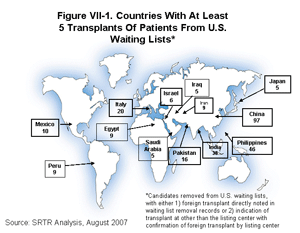
Table VII-3 shows the 35 countries where foreign transplants were performed. In addition, 55 transplants (15%) occurred in unspecified foreign nations and one was performed in an unspecified European country. Three countries accounted for one-half of all the foreign transplants. The largest number took place in China (n=97; 26%), followed by the Philippines (n=46; 12%) and India (n=38; 10%). Figure VII-1 shows the 13 countries where at least five foreign transplants were performed.
Table VII-3. Foreign Transplant Cases by Country
Destination Country and |
Directly reported cases |
From data validation |
Total foreign cases |
|||
|---|---|---|---|---|---|---|
Number |
Percent |
Number |
Percent |
Number |
Percent |
|
East Asia & Pacific |
80 | 46% | 76 | 38% | 156 | 42% |
China |
59 | 34% | 38 | 19% | 97 | 26% |
Philippines |
16 | 9% | 30 | 15% | 46 | 12% |
Korea |
3 | 2% | 1 | 1% | 4 | 1% |
Japan |
1 | 1% | 4 | 2% | 5 | 1% |
Singapore |
0 | 0% | 2 | 1% | 2 | 1% |
Thailand |
1 | 1% | 1 | 1% | 2 | 1% |
Europe |
13 | 8% | 18 | 9% | 31 | 8% |
Italy |
9 | 5% | 11 | 6% | 20 | 5% |
Turkey |
0 | 0% | 3 | 2% | 3 | 1% |
England |
1 | 1% | 1 | 1% | 2 | 1% |
Europe (unspecified) |
0 | 0% | 1 | 1% | 1 | 0% |
France |
1 | 1% | 0 | 0% | 1 | 0% |
Germany |
0 | 0% | 1 | 1% | 1 | 0% |
Norway |
1 | 1% | 0 | 0% | 1 | 0% |
Russia |
1 | 1% | 0 | 0% | 1 | 0% |
Spain |
0 | 0% | 1 | 1% | 1 | 0% |
Middle East & North Africa |
13 | 8% | 23 | 12% | 36 | 10% |
Egypt |
5 | 3% | 4 | 2% | 9 | 2% |
Iran |
3 | 2% | 6 | 3% | 9 | 2% |
Israel |
1 | 1% | 5 | 3% | 6 | 2% |
Iraq |
2 | 1% | 3 | 2% | 5 | 1% |
Saudi Arabia |
1 | 1% | 4 | 2% | 5 | 1% |
Lebanon |
1 | 1% | 1 | 1% | 2 | 1% |
South Asia |
28 | 16% | 26 | 13% | 54 | 14% |
India |
22 | 13% | 16 | 8% | 38 | 10% |
Pakistan |
6 | 3% | 10 | 5% | 16 | 4% |
Western Hemisphere |
17 | 10% | 23 | 12% | 40 | 11% |
Mexico |
5 | 3% | 5 | 3% | 10 | 3% |
Peru |
6 | 3% | 3 | 2% | 9 | 2% |
Columbia |
0 | 0% | 4 | 2% | 4 | 1% |
Argentina |
2 | 1% | 1 | 1% | 3 | 1% |
Canada |
2 | 1% | 1 | 1% | 3 | 1% |
Venezuela |
0 | 0% | 3 | 2% | 3 | 1% |
Brazil |
1 | 1% | 1 | 1% | 2 | 1% |
Dominican Republic |
0 | 0% | 2 | 1% | 2 | 1% |
Bolivia |
0 | 0% | 1 | 1% | 1 | 0% |
Chile |
1 | 1% | 0 | 0% | 1 | 0% |
El Salvador |
0 | 0% | 1 | 1% | 1 | 0% |
Uruguay |
0 | 0% | 1 | 1% | 1 | 0% |
Oceania |
0 | 0% | 1 | 1% | 1 | 0% |
Australia |
0 | 0% | 1 | 1% | 1 | 0% |
Unspecified |
22 | 13% | 33 | 17% | 55 | 15% |
Total |
173 | 100% | 200 | 100% | 373 | 100% |
 | Click for larger image Click to view slides for entire chapter |
Characteristics of the foreign transplant recipients are shown in Table VII-4. All but five (1.3%) of the recipients were adults, almost two-thirds were male, and just under one-half were Asian. Compared to wait-listed candidates, foreign transplant recipients were significantly more likely to be adult and male (P=0.0007 and P=0.0023, respectively), and were more than 10 times as likely to be Asian (P<0.0001). The proportion of foreign transplant recipients with college or graduate degrees was twice that of wait-listed candidates (P<0.0001), and for primary payment source, foreign transplant recipients were more than 10 times as likely to have indicated at the time of listing that their transplant was self-funded (8.9% vs. 0.8%, P<0.0001). The foreign transplant recipients were comprised of U.S. citizens (62%), resident aliens (13%), and non-resident aliens (16%). This compared to more than 96% U.S. citizenship among wait-listed candidates (P<0.0001).
Table VII-4. Characteristics of Foreign and Non-Foreign Transplant Cases
|
|
Wait-listed Candidates |
||||||
|---|---|---|---|---|---|---|---|---|
Directly reported cases |
From data validation |
Total foreign cases |
||||||
Number |
Percent |
Number |
Percent |
Number |
Percent |
Number |
Percent |
|
Age |
||||||||
<1 |
2 | 1.16% | 1 | 0.50% | 3 | 0.80% | 7380 | 1.49% |
1-5 |
1 | 0.58% | 0 | 0.00% | 1 | 0.27% | 6363 | 1.29% |
6-10 |
1 | 0.58% | 0 | 0.00% | 1 | 0.27% | 4069 | 0.82% |
11-17 |
0 | 0.00% | 0 | 0.00% | 0 | 0.00% | 11163 | 2.26% |
18-34 |
22 | 12.72% | 29 | 14.50% | 51 | 13.67% | 70543 | 14.27% |
35-49 |
57 | 32.95% | 76 | 35.00% | 127 | 34.05% | 163260 | 33.03% |
50-64 |
63 | 36.42% | 76 | 38.00% | 139 | 37.27% | 190571 | 38.56% |
65+ |
9 | 5.20% | 12 | 6.00% | 21 | 5.63% | 40797 | 8.25% |
Unknown/Missing |
18 | 10.40% | 12 | 6.00% | 30 | 8.04% | 104 | 0.02% |
Gender |
||||||||
Female |
51 | 29.48% | 58 | 29.00% | 109 | 29.22% | 197012 | 39.86% |
Male |
104 | 60.12% | 130 | 65.00% | 234 | 62.73% | 297190 | 60.13% |
Unknown/Missing |
18 | 10.40% | 12 | 6.00% | 30 | 8.04% | 48 | 0.01% |
Race/Ethnicity |
||||||||
White |
51 | 29.48% | 55 | 27.50% | 106 | 28.42% | 306130 | 61.94% |
Black or African American |
5 | 2.89% | 7 | 3.50% | 12 | 3.22% | 101463 | 20.53% |
Multi-Racial |
0 | 0.00% | 1 | 0.50% | 1 | 0.27% | 808 | 0.16% |
American Indian or Alaska Native |
0 | 0.00% | 0 | 0.00% | 0 | 0.00% | 4116 | 0.83% |
Asian |
92 | 53.18% | 87 | 43.50% | 179 | 47.99% | 20325 | 4.11% |
Native Hawaiian/Other Pacific Islander |
1 | 0.58% | 8 | 4.00% | 9 | 2.41% | 2252 | 0.46% |
Hispanic/Latino |
6 | 3.47% | 30 | 15.00% | 36 | 9.65% | 59095 | 11.96% |
Unknown/Missing |
18 | 10.40% | 12 | 6.00% | 30 | 8.04% | 61 | 0.01% |
Educational Status |
||||||||
None |
0 | 0.00% | 2 | 1.00% | 2 | 0.54% | 2686 | 0.54% |
Grade school (0-8) |
12 | 6.94% | 5 | 2.50% | 17 | 4.56% | 28212 | 5.71% |
High school (9-12) |
31 | 17.92% | 22 | 11.00% | 53 | 14.21% | 172033 | 34.81% |
Attended college/technical school |
28 | 16.18% | 38 | 19.00% | 66 | 17.69% | 87191 | 17.64% |
Associate/bachelor degree |
25 | 14.45% | 38 | 19.00% | 63 | 16.89% | 53333 | 10.79% |
Post-college graduate degree |
26 | 15.03% | 31 | 15.50% | 57 | 15.28% | 21838 | 4.42% |
Not applicable (< 5 years old) |
2 | 1.16% | 1 | 0.50% | 3 | 0.80% | 12944 | 2.62% |
Unknown/Missing |
49 | 28.32% | 63 | 31.50% | 112 | 30.03% | 116013 | 23.47% |
Employment Status |
||||||||
Working full time |
42 | 24.28% | 46 | 23.00% | 88 | 23.59% | 98334 | 19.90% |
Working part time by choice |
3 | 1.73% | 7 | 3.50% | 10 | 2.68% | 6378 | 1.29% |
Working part time due to disease |
3 | 1.73% | 7 | 3.50% | 10 | 2.68% | 17310 | 3.50% |
Working part time, reason unknown |
1 | 0.58% | 2 | 1.00% | 3 | 0.80% | 1661 | 0.34% |
Not working by choice |
5 | 2.89% | 6 | 3.00% | 11 | 2.95% | 11022 | 2.23% |
Not working due to disease |
29 | 16.76% | 39 | 19.50% | 68 | 18.23% | 145235 | 29.38% |
Not working, unable to find employment |
0 | 0.00% | 2 | 1.00% | 2 | 0.54% | 1460 | 0.30% |
Not working, reason unknown |
5 | 2.89% | 8 | 4.00% | 13 | 3.49% | 13260 | 2.68% |
Retired |
9 | 5.20% | 12 | 6.00% | 21 | 5.63% | 33607 | 6.80% |
Patient < 5 years old |
2 | 1.16% | 1 | 0.50% | 3 | 0.80% | 10580 | 2.14% |
Unknown/Missing |
74 | 42.77% | 70 | 35.00% | 144 | 38.61% | 155403 | 31.44% |
Primary Source of Payment |
||||||||
Private insurance |
86 | 49.71% | 102 | 51.00% | 188 | 50.40% | 250848 | 50.75% |
Medicaid |
8 | 4.62% | 14 | 7.00% | 22 | 5.90% | 51991 | 10.52% |
Medicare Fee for Service |
10 | 5.78% | 5 | 2.50% | 15 | 4.02% | 27872 | 5.64% |
Medicare & Choice |
1 | 0.58% | 3 | 1.50% | 4 | 1.07% | 11289 | 2.28% |
Medicare Unspecified |
29 | 16.76% | 21 | 10.50% | 50 | 13.40% | 126825 | 25.66% |
CHIP |
0 | 0.00% | 0 | 0.00% | 0 | 0.00% | 242 | 0.05% |
Department of VA |
0 | 0.00% | 1 | 0.50% | 1 | 0.27% | 2966 | 0.60% |
Other government |
0 | 0.00% | 1 | 0.50% | 1 | 0.27% | 1222 | 0.25% |
Self |
7 | 4.05% | 26 | 13.00% | 33 | 8.85% | 3862 | 0.78% |
Donation |
0 | 0.00% | 2 | 1.00% | 2 | 0.54% | 178 | 0.04% |
Free Care |
1 | 0.58% | 0 | 0.00% | 1 | 0.27% | 1300 | 0.26% |
Pending |
2 | 1.16% | 4 | 2.00% | 6 | 1.61% | 3841 | 0.78% |
Foreign Government |
7 | 4.05% | 7 | 3.50% | 14 | 3.75% | 831 | 0.17% |
US/State Govt. Agency |
3 | 1.73% | 2 | 1.00% | 5 | 1.34% | 7956 | 1.61% |
Unknown/Missing |
19 | 10.98% | 12 | 6.00% | 31 | 8.31% | 3027 | 0.61% |
Citizenship Status |
||||||||
US citizen |
110 | 63.58% | 122 | 61.00% | 232 | 61.20% | 475026 | 96.11% |
Resident alien |
26 | 15.03% | 24 | 12.00% | 50 | 13.40% | 13240 | 2.68% |
Non-resident alien |
19 | 10.98% | 42 | 21.00% | 61 | 16.35% | 4645 | 0.94% |
Unknown/Missing |
18 | 10.40% | 12 | 6.00% | 30 | 8.04% | 1339 | 0.27% |
Patients with permanent residence in 34 states plus the District of Columbia were represented among the foreign transplant cases (Table VII-5). Residents of California and New York accounted for 32% and 13% of the cases, respectively. This compares to 15% and 8%, respectively, of waiting list candidates from these two states (P<0.0001 and P=0.0005, respectively).
Table VII-5. State of Permanent Residence
|
|
Wait-listed Candidates Who |
||
|---|---|---|---|---|
| Number | Percent | Number | Percent | |
Alaska |
0 | 0.00% | 562 | 0.11% |
Alabama |
1 | 0.30% | 7012 | 1.43% |
Arkansas |
0 | 0.00% | 3375 | 0.69% |
Arizona |
2 | 0.61% | 7701 | 1.57% |
California |
105 | 31.82% | 72252 | 14.71% |
Colorado |
3 | 0.91% | 6359 | 1.29% |
Connecticut |
0 | 0.00% | 4968 | 1.01% |
District of Columbia |
1 | 0.30% | 1605 | 0.33% |
Delaware |
0 | 0.00% | 2015 | 0.41% |
Florida |
5 | 1.52% | 24224 | 4.93% |
Georgia |
1 | 0.30% | 10565 | 2.15% |
Hawaii |
3 | 0.91% | 2033 | 0.41% |
Iowa |
1 | 0.30% | 4115 | 0.84% |
Idaho |
1 | 0.30% | 1263 | 0.26% |
Illinois |
16 | 4.85% | 26254 | 5.34% |
Indiana |
2 | 0.61% | 9154 | 1.86% |
Kansas |
2 | 0.61% | 2947 | 0.60% |
Kentucky |
0 | 0.00% | 5452 | 1.11% |
Louisiana |
4 | 1.21% | 7811 | 1.59% |
Massachusetts |
3 | 0.91% | 9600 | 1.95% |
Maryland |
16 | 4.85% | 13338 | 2.72% |
Maine |
0 | 0.00% | 1574 | 0.32% |
Michigan |
12 | 3.64% | 17147 | 3.49% |
Minnesota |
4 | 1.21% | 8040 | 1.64% |
Missouri |
4 | 1.21% | 8375 | 1.70% |
Mississippi |
0 | 0.00% | 4768 | 0.97% |
Montana |
0 | 0.00% | 1009 | 0.21% |
Nebraska |
1 | 0.30% | 2487 | 0.51% |
Nevada |
3 | 0.91% | 3201 | 0.65% |
New Hampshire |
1 | 0.30% | 1435 | 0.29% |
New Jersey |
21 | 6.36% | 19169 | 3.90% |
New Mexico |
0 | 0.00% | 2538 | 0.52% |
New York |
43 | 13.03% | 37537 | 7.64% |
North Carolina |
1 | 0.30% | 13080 | 2.66% |
North Dakota |
0 | 0.00% | 1003 | 0.20% |
Ohio |
1 | 0.30% | 16728 | 3.41% |
Oklahoma |
3 | 0.91% | 4870 | 0.99% |
Oregon |
0 | 0.00% | 3090 | 0.63% |
Pennsylvania |
9 | 2.73% | 29480 | 6.00% |
Puerto Rico |
0 | 0.00% | 2687 | 0.55% |
Rhode Island |
0 | 0.00% | 1493 | 0.30% |
South Carolina |
1 | 0.30% | 6342 | 1.29% |
South Dakota |
0 | 0.00% | 1195 | 0.24% |
Tennessee |
1 | 0.30% | 8214 | 1.67% |
Texas |
12 | 3.64% | 34014 | 6.92% |
Utah |
0 | 0.00% | 2297 | 0.47% |
Virginia |
9 | 2.73% | 13629 | 2.77% |
Vermont |
1 | 0.30% | 808 | 0.16% |
Washington |
3 | 0.91% | 7256 | 1.48% |
Wisconsin |
2 | 0.61% | 10045 | 2.04% |
West Virginia |
0 | 0.00% | 2983 | 0.61% |
Wyoming |
0 | 0.00% | 576 | 0.12% |
Foreign Country |
32 | 9.70% | 1578 | 0.32% |
A multivariable Cox model was fitted to identify independent predictors of foreign transplant among candidates on the waiting list. There was a significant increase in the occurrence of foreign transplant over time, averaging 18% per year (Table VII-6), although the most dramatic increases have occurred in the past few years, as noted above. Males were 41% more likely to receive foreign transplants than females. As in the univariate analysis, Asians were more than 10-fold more likely than non-Asians to receive foreign transplants. Candidates with at least a college education had a foreign transplant rate that was more than 150% higher than that of less educated candidates. Although the univariate analyses showed that foreign transplant rates were higher among patients who were working at the time of wait-listing and those who indicated self-payment as the primary source of funding for their transplant, neither of these factors were found to be independently associated with foreign transplant when the other variables were included in the model. Finally, although place of U.S. residence was not an independent predictor, resident alien and especially non-resident alien status each were significantly associated with markedly higher relative rates of foreign transplant compared to U.S. citizens.
Table VII-6. Factors Independently Associated with Foreign Transplant among 494,463 Candidates Wait-Listed Between 1986 and 2006
Variable |
|
95% |
|
|---|---|---|---|
Male (vs. female) |
1.41 | 1.13, 1.75 | 0.002 |
Asian (vs. non-Asian) |
11.24 | 8.92, 14.17 | <0.0001 |
College education (vs. non-college education) |
2.57 | 1.99, 3.31 | <0.0001 |
Working (vs. not working) |
1.09 | 0.86, 1.39 | 0.482 |
Self payment (vs. not self-payment) |
1.46 | 0.90, 2.36 | 0.126 |
New York residence (vs. all but New York/California) |
1.36 | 0.97, 1.90 | 0.073 |
California residence (vs. all but New York/California) |
0.95 | 0.74, 1.21 | 0.657 |
Resident alien (vs. US citizen) |
2.78 | 2.02, 3.84 | <0.0001 |
Non-resident alien (vs. US citizen) |
11.85 | 8.16, 17.22 | <0.0001 |
Wait-list year (per year) |
1.18 | 1.13, 1.22 | <0.0001 |
This chapter represents the most comprehensive national effort to document the incidence of foreign travel for transplantation among wait-listed candidates in the U.S. Although this activity represents a very small proportion of the total number of transplants performed, it is clear that the number of foreign transplants for U.S. wait-listed candidates is increasing over time. In addition, current data reporting mechanisms are inadequate to capture the true extent of this practice.
Some observations can be made and preliminary conclusions drawn from the information that is available. Those who traveled abroad from the U.S. were not typical of the general pool of wait-listed patients. In descriptive statistics and univariate analyses, Asian adults were found to be disproportionately represented, as were those with higher levels of achieved education and the means to self-fund their transplant expenses. Candidates from California and New York, the former also separately associated with a higher proportion of Asian candidates, were much more likely to have traveled abroad for their transplants. These individuals were more likely to be retired from the workforce and less likely to be not working due to their disease. Taken together, these observations suggest that the cost, inconvenience, and potential hazard of travel for a patient with chronic organ failure imposed a degree of self-selection driven by a combination of means, motivation, and relative medical stability. These conclusions are further supported by the vast preponderance of kidney transplants among foreign transplant cases reported here. Interestingly, U.S. citizens were much less likely, and both resident and non-resident aliens much more likely, to pursue foreign transplantation. It is possible that both resident aliens and non-resident aliens are drawn to their country of origin for foreign transplants, although we do not have specific data on this point.
In order to better distinguish those factors that were independently associated with foreign transplant, we fitted a multivariable Cox regression model to the candidate pool. In this analysis, the factors that were significant included male sex, Asian race/ethnicity, college education, and non-U.S. citizen status. Employment status was not a significant independent predictor with the other factors present in the model. Similarly, even though residence in California or New York was significant in the univariate analysis, it is likely that collinearity with other covariates accounted for the lack of a significant independent association in the multivariable model.
The cases reported here represent a minimum number of foreign transplants that underestimate the true extent of this activity. Candidates had to have been placed on the waiting list in order for us to identify a subsequent foreign transplant with the available methods. Determination of the number of foreign transplants among those who were never on the waiting list would be entirely speculative. For some of the reasons mentioned above relating to the requirement for relative medical stability, however, additional cases among never-wait-listed persons could easily outnumber those reported here. Such cases might not even be known to transplant centers, as patients might pursue this avenue without even being formally evaluated for a transplant.
Waiting list removal records with almost any one of the available codes, aside from transplantation at the listing center or death, could represent additional occult cases of foreign transplantation. We have here identified only two specific waiting list removal codes where foreign transplants have been implicitly or explicitly identified. One waiting list removal code, “transplanted at another center,” required careful cross-referencing and data validation. In part, the validation study showed that a few data entry errors had occurred or that there may have been inadequate understanding of the proper use of the code (which was intended for U.S. transplants). In some instances, a U.S. transplant center was identified by the listing center in response to the data validation query, even though established SRTR person-linking algorithms failed to identify the match between the listed candidate and a transplant that had taken place elsewhere in the U.S. In a few cases, the transplant had actually occurred at the listing center and the center indicated that the “transplant at another center” removal code had been chosen in error. However, in more than 60% of the cases where “transplant at another center” had been used and where the listing center confirmed their knowledge that the patient had indeed been transplanted (in their response to the data validation query), the center also confirmed that the transplant had occurred in a foreign country.
Waiting list removals using other removal reason codes may also represent instances of foreign transplantation. For example, “too sick to transplant,” “medically unsuitable,” “patient choice,” and “recovered” are just a few examples of waiting list removal codes that may represent occult instances of foreign transplantation. This is not to imply any failure or malfeasance on the part of the listing center. In fact, anecdotal information suggests that at least some foreign transplants occur without any prior knowledge on the part of transplant center personnel. This study did not include investigation of whether organ selling, brokering, or trafficking was involved in any cases.
The availability of a miscellaneous waiting list removal code called “other – specify,” which permits centers to add a text entry, was used to identify nearly 200 cases of foreign transplantation. Overall, however, only a small proportion of waiting list removals that used this code had a text entry, and careful searching of the text field was required to identify these cases. It is very likely that many more foreign transplant cases exist where the text field was simply left blank.
The term “transplant tourism” has been used to indicate travel outside of one’s country of residence for the principal purpose of obtaining organ transplantation services (1-4). There is a connotation of impropriety at best and illegality at worst in the use of this designation. We have chosen to denote the cases reported here as “foreign transplants” because of the limited information available to us regarding the specific details of these cases. On one hand, it is possible and indeed probable that instances of organ buying, selling, and/or trafficking outside the U.S. occurred. On the other hand, bona fide emotionally and/or biologically related living donor transplants were likely done. For example, U.S. citizens as well as resident and non-resident aliens may have friends or relatives in their country of origin who are unable to come to the U.S. to donate because of restrictive policies governing the issuance of travel visas. If there is a transplant program in the country of origin, the candidate may choose instead to travel abroad to the donor’s location. This latter situation is emblematic of the complicated and increasingly mobile world in which we live, but on its face is not problematic from an ethical or legal standpoint. On an individual basis, differentiating between the two scenarios may be difficult if not impossible, for transplant teams, payers, and the government.
The outcome of commercial transplants has been reported to be inferior to that of domestic transplants (5). In the U.S., only small case series have been reported (3). It is unknown, however, whether traditional living donor and/or deceased donor transplants in countries outside the U.S. have significantly worse or better outcomes, because very few studies on this subject have been undertaken. There has been a report of similar outcomes of commercial and domestic kidney transplants in Taiwan (6). The Global Alliance in Transplantation (7), a project of The Transplantation Society, has begun to explore international comparisons of transplant outcomes that may aid in sorting out these questions (8). However, because there are many disparate methodologies used by various transplant registries around the globe, one focus of an international workshop planned for late 2007 will concentrate on this issue.
There are many downstream effects of foreign transplantation on the transplant system in the U.S. It is important to examine the outcomes of foreign transplants so that potential transplant candidates may be appropriately counseled. Since the full extent of foreign transplants of U.S-listed candidates cannot be determined using existing data, and identification of foreign transplants among those who have not been placed on the waiting list is currently impossible, additional reporting requirements may be necessary. There is a need to improve coding options for the reasons for waiting list removal to more accurately and consistently identify foreign transplants. A unique code for transplants that occur outside the U.S. should be created that captures these events, and which also triggers requests for follow-up information. The latter is not now part of the OPTN data collection system, because waiting list removals for transplant at the listing center are the only current triggers for follow-up form generation. The SRTR has recently made these recommendations to HRSA and to the OPTN, which is the entity responsible for data collection in the U.S. Additionally, reporting of transplants that have occurred outside the U.S. in the absence of any wait-listing event should also be reported to the OPTN and should become part of the reported follow-up experience. This requirement already exists for living donor transplants performed in the U.S. without wait-listing. Lastly, because of the public health implications of potential introduction of transmissible infectious diseases by immunosuppressed recipients of foreign transplantation, increased transparency about these practices appears warranted. More complete ascertainment and appropriate oversight of foreign transplant activity will contribute to the discharge of our collective responsibility for the transplant system in the U.S.
[TOC]1. Ghods AJ, Nasrollahzadeh D. Transplant tourism and the Iranian model of renal transplantation program: ethical considerations. Exp Clin Transplant Dec 2005;3(2):351-354.
2. Bramstedt KA, Xu J. Checklist: passport, plane ticket, organ transplant. Am J Transplant Jul 2007;7(7):1698-1701.
3. Canales MT, Kasiske BL, Rosenberg ME. Transplant tourism: Outcomes of United States residents who undergo kidney transplantation overseas. Transplantation Dec 27 2006;82(12):1658-1661.
4. Bass D. Kidneys for cash and egg safaris--can we allow 'transplant tourism' to flourish in South Africa? S Afr Med J Jan 2005;95(1):42-44.
5. Prasad GV, Shukla A, Huang M, RJ DAH, Zaltzman JS. Outcomes of commercial renal transplantation: a Canadian experience. Transplantation Nov 15 2006;82(9):1130-1135.
6. Sun CY, Lee CC, Chang CT, Hung CC, Wu MS. Commercial cadaveric renal transplant: an ethical rather than medical issue. Clin Transplant May-Jun 2006;20(3):340-345.
7. Groth CG, Chapman JR. The Global Alliance for Transplantation. Transplantation May 15 2005;79(9):994-996.
8. Chapman JR, Groth CG, Wood KJ. The needs for a Global Alliance for Transplantation. Clin Transpl 2005:273-279.