
CHAPTER I
Trends in Organ Donation and Transplantation in the United States, 1997-2006
[TOC]This chapter provides an overview of solid organ transplantation in the United States, and is produced as part of the 2007 OPTN/SRTR Annual Report. The Annual Report is prepared by the Scientific Registry of Transplant Recipients (SRTR) in collaboration with the Organ Procurement and Transplantation Network (OPTN) under contract with the Health Resources and Services Administration (HRSA). The report covers many aspects of solid organ transplantation and is a valuable resource for patients, the transplant community, the public, and the Federal Government.
This report includes nine chapters devoted to specific topics in solid organ transplantation. Each chapter was written by a group of experts in the field of transplantation and provides a comprehensive look at the current state of transplantation and trends over the past decade. The text and figures in these chapters are based on recent SRTR analyses and the extensive reference tables of the 2007 Annual Report, which were prepared by the Arbor Research Collaborative for Health, which with the University of Michigan has been the contractor for the SRTR since October 2000. These nine chapters and extensive reference tables are available online, at the websites of the SRTR and OPTN (www.ustransplant.org and optn.transplant.hrsa.gov).
SUMMARY STATISTICS ON ORGAN TRANSPLANTATION IN THE UNITED STATES
[TOC]As of the end of 2005 there were 163,631 persons living with a functioning organ transplant in the United States [Table 1.14]. This number reflects an increase of 2.1% over the prior year and a 1.6-fold increase since 1997.
The total number of organs transplanted annually increased from 27,530 in 2005 to 28,291 in 2006, an increase of 761 (2.8%). This overall increase is attributable to different levels of transplant activity by organ. There was a 7.4% increase in deceased donor kidney transplants (Table I-1). Other notable changes include a 2.3% increase in liver transplants, which occurred despite a decrease in living donor liver procedures that year. Lung transplantation remained stable, while heart transplantation increased 4.1%. Percentage declines in transplantation for pancreas, intestine, and heart-lung reflect relatively small changes in the numbers of transplants. The 28,291 organs transplanted in 2006 came from 14,756 organ donors, 265 more donors than there were in 2005 (2%) [Table 1.1]. The year-over-year increase in the total number of donors resulted from a substantial increase in deceased donors (431, or 6%) and a slight decrease in living donors (166, or 2%). The number of living donors in 2006 was observed to be lower than any year since 2002. The overall 5.1% increase in organ recovery in 2006 was driven primarily by the 7.3% increase in recovered kidneys. Increases were also seen in liver, heart, and lung procurement, while pancreas and intestine procurement remained relatively stable (Table I-2).
Table I-1. Growth in Number of Transplanted Organs, 2005-2006
| Transplanted Organs | 2005 | 2006 | Percent Change |
| Total | 27,530 | 28,291 | 2.8% |
| Deceased donor | 20,633 | 21,561 | 4.5% |
| Living donor | 6,897 | 6,730 | -2.4% |
| Kidney | 16,076 | 16,646 | 3.5% |
| Deceased donor | 9,508 | 10,212 | 7.4% |
| Living donor | 6,568 | 6,434 | -2.0% |
| Pancreas | 1,368 | 1,304 | -4.7% |
| Pancreas alone | 129 | 98 | -24.0% |
| Pancreas after kidney | 343 | 292 | -14.9% |
| Kidney-pancreas | 896 | 914 | 2.0% |
| Liver | 6,000 | 6,136 | 2.3% |
| Deceased donor | 5,679 | 5,849 | 3.0% |
| Living donor | 321 | 287 | -10.6% |
| Intestine | 68 | 60 | -11.8% |
| Deceased donor | 63 | 57 | -9.5% |
| Living donor | 5 | 3 | -40.0% |
| Heart | 2,062 | 2,147 | 4.1% |
| Deceased donor | 2,062 | 2,146 | 4.1% |
| Living donor | - | 1 | - |
| Lung | 1,403 | 1,401 | -0.1% |
| Deceased donor | 1,402 | 1,397 | -0.4% |
| Living donor | 1 | 4 | 300.0% |
| Heart-lung | 34 | 31 | -8.8% |
Table I-2. Change in Number of Organs Recovered from Deceased Donors, 2005-2006
| Recovered Organs | 2005 | 2006 | Percent Change |
| Total | 26,920 | 28,311 | 5.1% |
| Kidney | 13,313 | 14,282 | 7.3% |
| Pancreas-All | 2,045 | 2,026 | -0.9% |
| Liver | 6,783 | 7,084 | 4.4% |
| Intestine | 185 | 184 | -0.5% |
| Heart | 2,220 | 2,275 | 2.5% |
| Lung | 2,374 | 2,460 | 3.6% |
There were approximately 94,000 people registered on organ waiting lists at the end of 2006 (64,373 actively waiting, 29,438 at “inactive” status, and 9 of unknown status), a 5.5% increase over the number of people waiting for an organ at the end of 2005 [Table 1.4]. Table I-3 shows the one-year change in the number of patients on the waiting list for each organ. This table includes patients listed at both active and inactive status. The kidney waiting list grew by 8.6% while the list for kidney-pancreas shrunk by 3.7%. Other modest declines were seen on the liver and heart lists; the largest decline (8.6%) was seen on the lung waiting list. Dramatic changes for lungs in 2005 and 2006 can be largely attributed to a new deceased donor lung allocation policy that was implemented in May 2005. The allocation policy was changed from a system based on waiting time to one based on net survival benefit from transplantation and medical urgency (the latter based on mortality risk while on the waiting list) (1). Changes in the solitary pancreas (pancreas transplant alone, or PTA), pancreas after kidney (PAK), intestine, and heart-lung waiting lists all reflect relatively small numbers of patients.
Table I-3. Patients on Waiting Lists (Total of Active and Inactive), 2005-2006
| Organs |
End of Year | Percent Change |
|
| 2005 | 2006 | ||
| Total |
93,114 |
98,263 |
5.5% |
| Kidney |
65,199 |
70,778 |
8.6% |
| Pancreas alone |
527 |
609 |
15.6% |
| Pancreas after kidney |
983 |
1,007 |
2.4% |
| Kidney-pancreas |
2,510 |
2,416 |
-3.7% |
| Liver |
17,465 |
17,371 |
-0.5% |
| Intestine |
202 |
238 |
17.8% |
| Heart |
2,934 |
2,822 |
-3.8% |
| Lung |
3,156 |
2,885 |
-8.6% |
| Heart-lung |
138 |
137 |
-0.7% |
The population of people awaiting a transplant has continued to shift toward older candidates. At the end of 2006, 59% of all candidates were 50 years old or older, and 14% were 65 or older. These percentages are slightly higher than they were in 2005 (57% ?50 years, 13% ?65 years) and substantially higher than they were in 1997 (43% ?50 years, 7% ?65 years) [Table 1.4].
Patient survival is an important metric for evaluating the success of transplantation. Table I-4 shows the percentage of transplant recipients still alive one and five years after transplantation, by organ. The cohort used to compute one-year survival consists of recipients transplanted in 2004-2005, while the cohort for five-year survival is based on recipients transplanted in 2000-2005. These are the most recent cohorts for which adequate follow-up data have been collected. One-year patient survival rates were highest for kidney recipients and pancreas recipients, ranging from about 95% to 98%. One-year survival for liver, intestine, lung, and heart recipients was approximately 81%-91%. Survival was lowest for the small number of heart-lung recipients: approximately 75% survived one year.
Table I-4. Unadjusted One- and Five-Year Patient Survival by Organ
| Organ Transplanted | 1-Year Survival | 5-Year Survival |
| Kidney | ||
| Deceased donor | 94.8% | 80.6% |
| Living donor | 98.0% | 90.3% |
| Pancreas alone | 96.7% | 88.1% |
| Pancreas after kidney | 96.6% | 83.9% |
| Kidney-pancreas | 95.0% | 86.1% |
| Liver | ||
| Deceased donor | 86.9% | 73.6% |
| Living donor | 90.6% | 76.1% |
| Intestine | 81.0% | 53.6% |
| Heart | 87.8% | 74.4% |
| Lung | 84.0% | 52.6% |
| Heart-lung | 75.0% | 49.7% |
Table I-5 shows the percentage of transplanted organs that were still functioning (graft survival) one and five years after transplantation, by organ. Graft survival was calculated using the same cohorts as patient survival (Table I-4), the most recent cohorts for which adequate follow-up data are available. Over 90% of kidneys transplanted alone or as part of a kidney-pancreas transplant were functioning one year after transplantation. Graft survival rates were lower than corresponding patient survival rates because some patients survived graft failure by receiving a subsequent transplant or alternative therapy such as dialysis or insulin therapy.
Table I-5. Unadjusted One- and Five-Year Graft Survival by Organ
| Organ Transplanted | 1-Year Survival | 5-Year Survival |
| Kidney | ||
| Deceased donor | 90.0% | 67.5% |
| Living donor | 97.3% | 80.2% |
| Pancreas alone | 80.1% | 50.6% |
| Pancreas after kidney | 78.5% | 58.1% |
| Kidney-pancreas (kidney) | 92.9% | 77.9% |
| Kidney-pancreas (pancreas) | 86.2% | 72.5% |
| Liver | ||
| Deceased donor | 82.3% | 67.6% |
| Living donor | 84.1% | 68.6% |
| Intestine | 73.4% | 36.9% |
| Heart | 87.3% | 73.2% |
| Lung | 82.3% | 49.7% |
| Heart-lung | 75.0% | 73.2% |
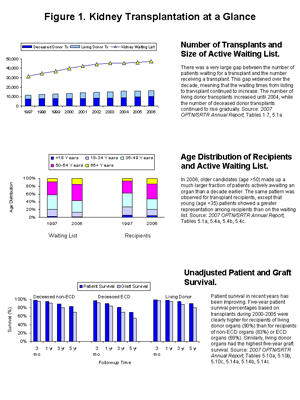
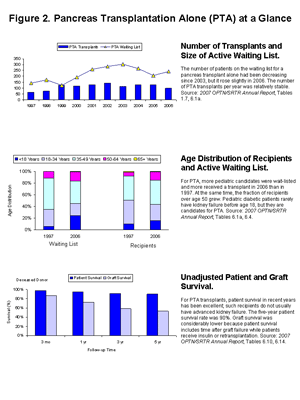
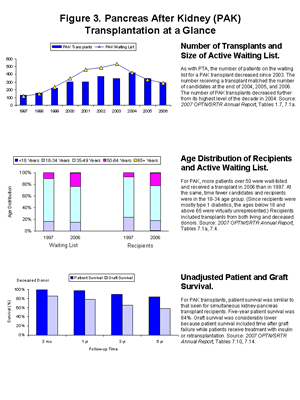
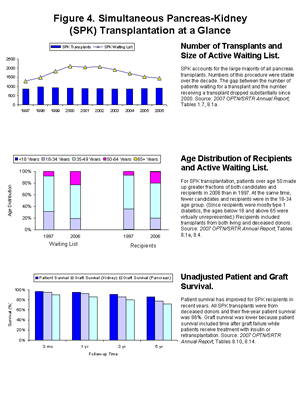
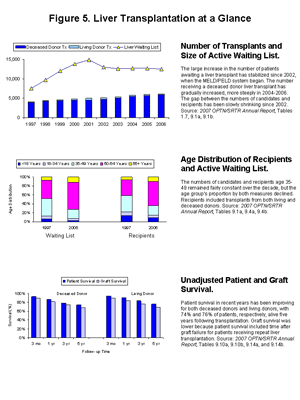
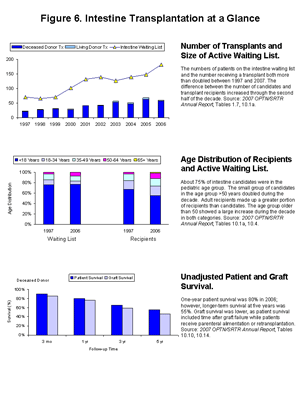
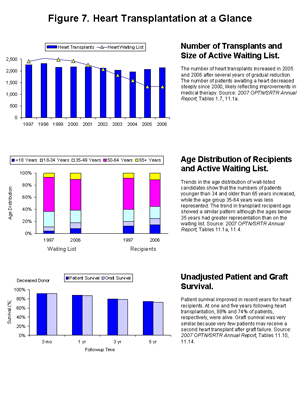
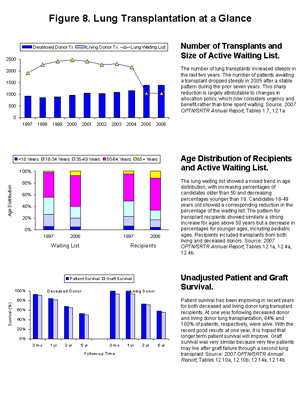
The full-page figures at the end of this chapter (Figures I-1 to I-8) offer “dashboard” views of the state of transplantation for different organs. These sets of summary graphics are included for six organs (kidney, pancreas transplant alone, pancreas after kidney, liver, intestine, heart, and lung) as well as the most common multi-organ procedure (simultaneous pancreas-kidney). Other multi-organ procedures are excluded from the counts presented here. For this overview, we have omitted separate figures for heart-lung transplants, given the extremely small numbers of these procedures. Below we describe the three types of graph shown for each organ.
 | Click for larger image Click to view slides for entire chapter |
 | Click for larger image Click to view slides for entire chapter |
 | Click for larger image Click to view slides for entire chapter |
 | Click for larger image Click to view slides for entire chapter |
 | Click for larger image Click to view slides for entire chapter |
 | Click for larger image Click to view slides for entire chapter |
 | Click for larger image Click to view slides for entire chapter |
 | Click for larger image Click to view slides for entire chapter |
Number of Transplants and Size of Active Waiting List
[TOC]These figures compare, for each of the last 10 years, the size of the active waiting list and the number of transplants performed. The size of the waiting list is a snapshot of the number of candidates active on the waiting list at the end of each year, although additional patients were listed or removed at some time during the year. The number of transplants includes all transplants performed over the year. This difference in methods of counting explains why for some organs (e.g., lung), the number of transplants performed during a certain year may exceed the number of people awaiting a transplant on the last day of the same year. Other instances of the narrowing gap between waiting list size and number of transplants reflect changes in allocation policy and wait-listing practices.
Age Distribution of Recipients and Active Waiting List
[TOC]This overview groups all pediatric patients (<18 years) together, for ease of viewing. The OPTN/SRTR Annual Report data tables (and the accompanying chapters analyzing them) divide this group into several age subgroups: <1 year, 1-5 years, 6-10 years, and 11-17 years. Here we have included only the data for 1997 and 2006; additional detail may be found in the organ-specific chapters of this report.
Unadjusted Patient and Graft Survival
[TOC]These overview figures show survival of transplant recipients (patient survival) and the transplanted organ (graft survival) at three months, one year, three years, and five years following transplantation. The figures are based on information about the most recent cohorts possible that allow sufficient follow-up time for data collection and ascertainment of events.
CHAPTERS IN THE 2007 OPTN/SRTR ANNUAL REPORT
[TOC]Figures I-1 to I-8 give a quick view of the major trends addressed and analyzed in each of the organ-specific chapters of this report. Chapters on kidney and pancreas (Chapter IV), liver and intestine (Chapter V), and heart and lung (Chapter VI) provide detailed trends in donation, waiting time, allocation, Post Transplant outcomes, and the demographics of both candidates and recipients. Additionally, these chapters supplement the reporting of 10-year trends with updates on recent changes in allocation policy, immunosuppression, clinical practice, and other areas relevant to the transplantation of different organ types.
In this year’s report, the three organ-specific chapters are preceded by a review of trends in organ donation and utilization (Chapter II) including recent efforts to increase the number of donors, and a chapter devoted to the particular outcomes and policy concerns of pediatric transplantation (Chapter III).
This year’s report concludes with three “special-focus” chapters that look closely at issues of recent interest to the transplant community. A chapter on “transplant tourism” (Chapter VII) examines the implications of patients on U.S. waiting lists who received transplants abroad. A chapter on the concept of “life years from transplant” (Chapter VIII) details the methodology used in recent SRTR work done in conjunction with the OPTN Kidney Committee in establishing a kidney allocation system that incorporates a measure of expected recipient benefit. Lastly, a chapter on performance measures (Chapter IX) introduces readers to the SRTR’s reports on transplant center and organ procurement organization outcomes. These chapters all include special analyses performed by the SRTR and touch on topics that are timely and have implications for policy and clinical practice.
[TOC]1. Egan TM, Murray S, Bustami RT, et al. The 2005 SRTR Report on the State of Transplantation: Development of the New Lung Allocation System in the United States. Am J Transplant 6:1212-1227, 2006.